


Most technology budgets are built from last year's invoices. The 2027 budget should be built from the capabilities your members and your examiners will expect next.
In Brief
A credit union technology strategy for 2027 should fund capabilities, not line items. Fraud and identity controls come first, followed by the core and data foundation that lets AI, digital account opening, and lending automation scale without adding cost faster than revenue. Boards should ask two things of every dollar: what does it enable, and what does it retire?
-
Fraud has the first claim on the budget: 63% of credit union executives reported more fraud in the past year (Wipfli, 2026).
-
Costs are outpacing growth: non-interest expense rose 7.4% year over year to $77.8 billion annualized, while total assets grew 5.0% (NCUA, Q2 2026).
-
AI is paying off where it is deployed: 59% of credit union executives say AI outcomes beat their expectations (Wipfli, 2026).
-
Scale pressure is sharpest at the small end: credit unions under $100 million lost 7.3% of their members in a year (NCUA, Q2 2026).
-
The most valuable budget line is often a retirement: consolidating vendors and custom integrations is how most credit unions will pay for new capability.
Key Terms
-
Technology budget: annual operating and capital spend on core processing, digital channels, integrations, security and data, including vendor fees.
- Run vs. change spend: "run" keeps current systems operating; "change" buys new capability.
-
Efficiency ratio: non-interest expense divided by net interest income plus non-interest income. A lower ratio means less cost per dollar of revenue.
-
Capability-based budgeting: funding outcomes, such as opening an account in minutes, instead of renewing tools by default.
-
Integration debt: the accumulated cost of custom connections, middleware and manual workarounds between systems.
Why does the 2027 credit union technology budget matter more than usual?
The 2027 budget arrives as costs outpace growth, fraud keeps climbing, and AI moves from pilot to production. NCUA data show non-interest expense up 7.4% in a year against 5.0% asset growth. Every new technology dollar now has to improve efficiency, not just add another system to maintain.
The system is also consolidating. There were 4,214 federally insured credit unions at mid-year, 156 fewer than a year earlier (NCUA, Q2 2026). Credit unions under $100 million posted a 0.43% return on average assets, against 0.94% for those above $500 million.
Vendor costs are rising too. Gartner forecasts worldwide IT spending of $7.35 trillion in 2027, up 15%, with memory-related inflation pressuring hardware (Gartner via Network World, Oct 2026). Expect that in renewal conversations.
What should a credit union board fund first in 2027?
Fund fraud and identity controls first, placed inside the account opening and payment workflows rather than bolted on afterward. Credit union executives report rising fraud, rising attacks and frequent access incidents. Half plan to expand AI investment aimed at fraud and financial crime, which makes this the line least likely to be cut.
The numbers from Wipfli's 2027 credit union industry research are hard to ignore (Wipfli, 2026):
-
63% reported more fraud in the past year.
- 52% reported an increase in cyberattacks.
- 73% identified at least one unauthorized network or data access incident in the last 12 months.
- 50% plan to expand AI investments focused on fraud and financial crime prevention (Wipfli press release, Nov 2026).
Placement matters as much as price. A fraud tool that sees real-time core data at account opening stops a synthetic identity before it becomes a member; one fed by a nightly batch file finds it after the loss. For a deeper look, see How Can Credit Unions Stop Deepfake and Synthetic Identity Fraud at Account Opening?
How should boards budget for AI without overcommitting?
Budget for specific workflows with measurable outcomes and for the data those workflows need, not for "AI" as a category. Early results are encouraging: most credit union executives using AI say outcomes beat expectations. Most expect no change in headcount, so the return shows up as capacity rather than fewer staff.
Wipfli found that 59% of credit union executives say AI outcomes exceeded expectations. Among executives whose institutions use AI, 71% expect no headcount change over the next 12 months, while 17% of respondents expect to add staff to support data and AI needs (Wipfli, 2026).
Three budget lines tend to decide whether AI works:
-
Data access: real-time, well-structured data from the core, reachable through documented APIs.
- Workflow ownership: a named owner and a baseline metric for each use case, such as loan decision time or exceptions handled per day.
- Governance: a clear view of how AI embedded in vendor products uses member data, reviewed before renewal.

Should the budget fund core modernization or extend the current core?
Decide on total cost and capability, not on the renewal date. If add-on fees, custom integrations and manual workarounds keep growing, extending the current core is itself a spending decision, often the larger one. The board's job is to compare both paths over the same three-to-five-year horizon.
Integration debt rarely appears as one line. It hides in middleware licenses, consultant hours and staff time spent re-keying data. Ask management to total it.
If the comparison points toward change, the budget should fund the evaluation well before contract notice deadlines, so a conversion remains a real option. Our guides to building a core conversion business case and legacy core replacement walk through that analysis.
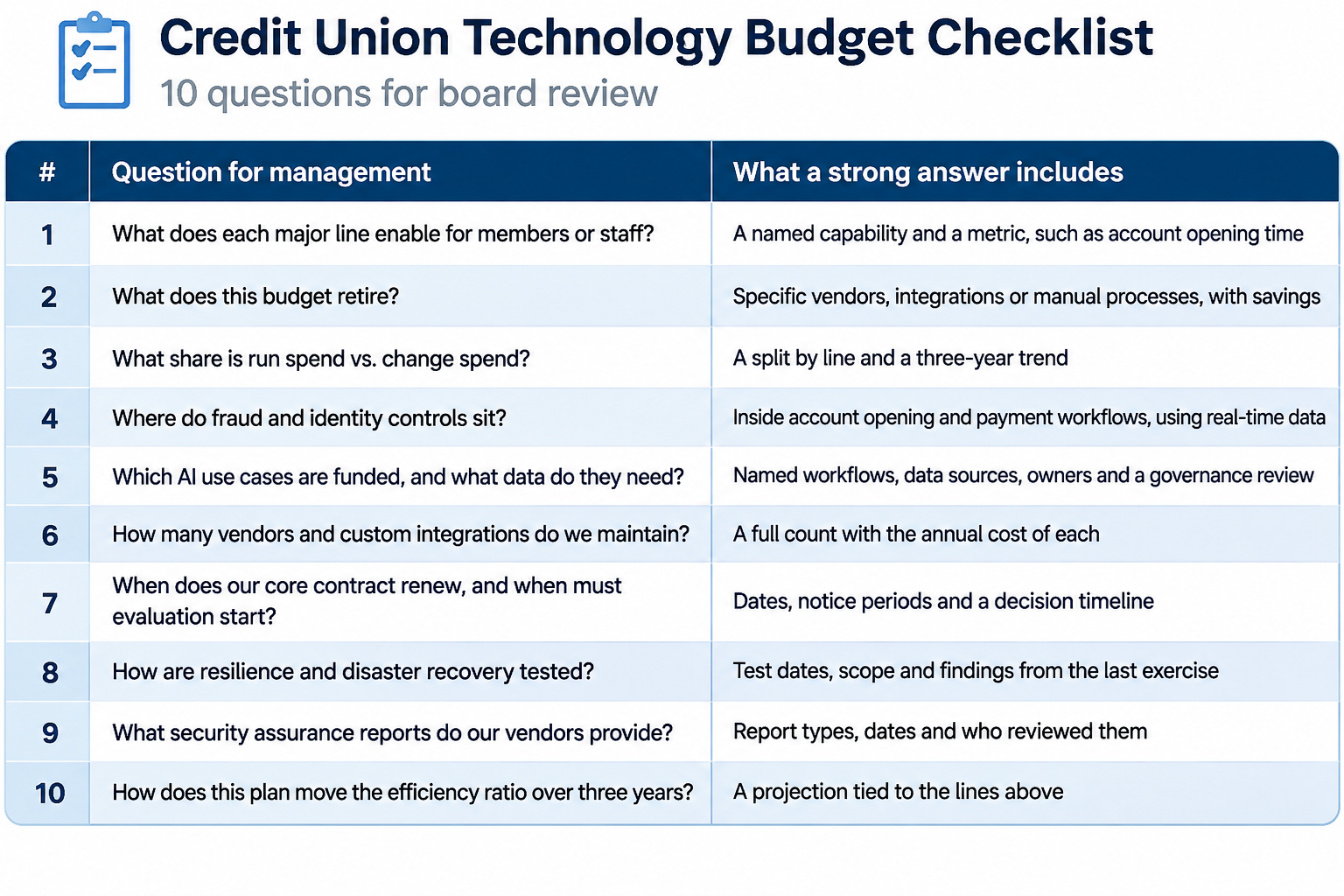
What questions should the board ask before approving the technology budget?
The board should ask what each major line enables, what it retires and how success will be measured. A consistent set of questions turns budget approval from a review of invoices into a review of strategy. Use this checklist in the budget meeting and again at mid-year.
How can smaller credit unions fund all of this?
By retiring roughly as much as they add. Smaller credit unions face the sharpest scale pressure, so new capability has to be paid for by consolidating vendors, removing custom integrations and automating manual work. A budget that only adds lines will widen the gap with larger peers.
The growth gap is visible in executive expectations. Wipfli found that 82% of executives at credit unions with $1 billion or more in assets project growth above 5%, against 43% of those under $1 billion (Wipfli, 2026). NCUA reports that about 56% of federally insured credit unions had fewer members than a year earlier (NCUA, Q2 2026).
For credit unions between $50 million and $500 million, the practical levers are:
-
Fewer vendors, with one accountable partner across core, digital, lending and onboarding.
- Pre-built integrations instead of custom API projects.
- Automation of high-volume manual work, measured in staff hours returned.
Our earlier post on 8 technology gaps mid-sized credit unions should address maps where those hours usually go.
FLEX perspective
FLEX Credit Union Technology has built credit union-native technology for 48 years, and our view is that consolidation is the most durable budget lever available. FLEX Core Banking pairs real-time, browser-based processing with pre-built partner integrations through the FLEXBridge API. Credit unions can then add fraud, lending and digital capabilities without funding a new custom integration each time.
Budget for the credit union you plan to be in 2029
A technology budget is a statement about which capabilities a credit union intends to own. Approving last year's lines plus inflation is also a decision, just an unexamined one.
Before the 2027 budget is final, try one exercise. Remove every line that exists only to keep another line working. What remains is your real technology strategy, and the difference is what you have to fund the next one.
Frequently Asked Questions
How much should a credit union spend on technology each year?
There is no universal percentage; the right level depends on asset size, growth plans and how much of the stack is outsourced. Benchmark against peers of similar size [DATA: technology spend as a share of operating expense by asset tier, suggested source Callahan & Associates or Cornerstone Advisors], then track the split between run and change spend.
What technology investments should a credit union board prioritize in the 2027 budget?
Start with fraud and identity controls, then fund the core and data foundation that AI, digital account opening and lending automation depend on. Pair each new investment with something it retires.
How should a credit union board evaluate AI spending?
Ask for named workflows, baseline metrics and the data each use case needs. Also ask how AI embedded in vendor products uses member data, and review that before contracts renew.
When should a credit union start evaluating a new core before its contract renews?
Early enough that changing cores remains a real option, which means before the contract's notice deadline, not after. Review the agreement for notice periods and auto-renewal terms, then build the evaluation timeline back from those dates.
How can a small credit union afford new technology?
Fund it by retiring cost: consolidate vendors, replace custom integrations with pre-built ones and automate manual work. A platform that covers core, digital, lending and onboarding together reduces the number of contracts and connections to maintain.
Reach out if you'd like to discuss further. To see how one credit union-native platform handles core, digital banking, lending, and onboarding together, schedule a demo of the most complete core solution.
Related reading: