


The merger vote closes one deal. The core conversion is the second deal, and members will judge the merger by it.
In Brief
For most merging credit unions, the right sequence is to complete the legal merger first and convert to a single core shortly after, with the surviving core chosen, data mapped, and mock conversions finished before legal close. The core decision itself belongs in merger due diligence, before the agreement is signed.
- Member accounts move to one system at or after the legal merger date; the work that makes that day uneventful happens months earlier.
- Merging credit unions choose among three paths: adopt the continuing credit union's core, convert both to a new core, or run both cores through a planned bridge period.
- Choose the surviving core on scalability, integration fit, and product coverage, not on which partner is larger.
- Technology drives much of a merger's cost savings, so a delayed conversion erodes the deal's rationale.
- Data mapping, repeated mock conversions and a dated member communication plan are the controls that most reduce conversion risk.
Key Terms
- Legal merger date: The effective date on which the merging credit union's assets, liabilities and members transfer to the continuing credit union under NCUA's merger rule, 12 CFR Part 708b.
- Continuing credit union: The institution whose charter survives the merger.
- Credit union core conversion: Moving member, share, loan, and transaction data from one core processing system to another, along with every integration that reads from it.
- Mock conversion: A full rehearsal of the data conversion in a test environment, used to find mapping and balancing errors before members do.
Why does every credit union merger include a core conversion decision?
Because two charters almost always arrive on two systems. Unless both credit unions already run the same core, the combined institution has to choose one platform, move every member record onto it, and reconnect every service that depends on it. That choice shapes the merger's timeline, cost, and member experience more than almost any other.
NCUA approved 157 credit union mergers in 2025 (Credit Union Times, February 2026) and 27 in the first quarter of 2026, 22 of them for expanded services (Credit Union Times, June 2026). In the third quarter of 2025 alone, approved mergers carried $34 billion in combined assets, more than all merger assets from 2022 through 2024 combined (CUToday, 2026).
Recent announcements show how varied the conversion horizon can be:
- SELCO Community Credit Union and Numerica Credit Union announced a merger of equals on October 28, with completion slated for 2028.
- A $224 million Alabama credit union announced on October 21 a merger into a larger Florida credit union, with integration continuing into 2028.
- MSUFCU and UFCU announced a $13.1 billion combination on October 13 with no conversion plan yet stated.
When expanded services justify a merger, the core is what has to deliver them.
Should we convert to one core before or after the legal merger?
In most cases, after. Member accounts belong to separate charters until the legal merger date, so the conversion itself happens at or after legal close. What moves "before" is the work: choosing the surviving core, cleaning and mapping data, and rehearsing the conversion so that conversion weekend is a scheduled event rather than a discovery exercise.
The real variable is the length of the gap. One pending merger lists a legal merge date of October 31 and a system conversion on November 15, 2026, a two-week bridge. Larger combinations often plan integration across one to two years.
- Short gap: fewer workarounds and a faster single member view, but readiness must be complete before close.
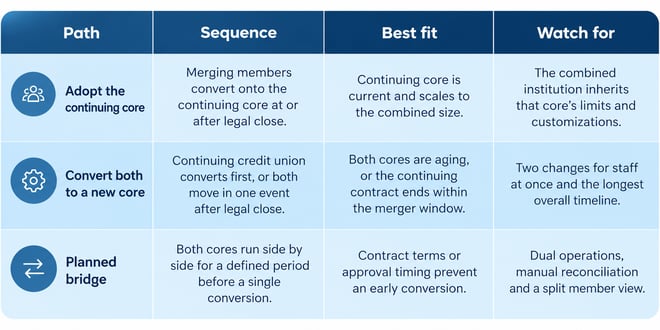
- Long gap: more preparation time, but staff run two systems and savings arrive later.
One exception: if the continuing credit union's core contract is near renewal, or its platform will strain at the combined size, settle the core question before signing the merger agreement. The answer may become "move both institutions to a new core."
What are the core conversion paths in a credit union merger?
Merging credit unions generally follow one of three paths. Most adopt the continuing credit union's existing core. Some use the merger to move both institutions to a new platform. Others run both cores through a planned bridge period because contract or approval timing forces a delay.
How do merging credit unions decide which core to keep?
Choose the core that will best serve the combined institution three years out, not the one the larger partner happens to run. Size often decides by default, yet the larger credit union's platform may carry the most customization, the heaviest integration load, or the most restrictive contract. Use these criteria during due diligence:
- Scalability: Can the core support the combined asset size, membership, and branch footprint without re-architecture?
- Staff access: Can staff in newly combined locations work in real time through a browser, without new local installs?
- Integration inventory: How many third-party connections must be rebuilt, and how many already exist as pre-built integrations rather than custom API work?
- Product coverage: Can it run both credit unions' share and loan products without new customization?
- Contract terms: When do renewals fall, and what deconversion fees and notice periods apply to the core being retired?
- Conversion support: Who staffs the conversion, and how many mock conversions are included?
- Security assurance: Which independent audit reports and disaster-recovery testing results will the provider share?

What does a merger core conversion plan look like, step by step?
A sound plan runs on two clocks: the legal merger clock and the technology clock. The technology clock should start first, during due diligence, so the core decision, data work, and rehearsals are nearly finished when members vote. Six steps keep the two clocks aligned.
- Decide the surviving core during due diligence. Document the choice and the reasoning in the merger plan, so both boards approve the same technology path.
- Inventory every system at both credit unions. Include loan origination, digital banking, card processing, bill pay, ACH, statements, and document imaging.
- Map and clean the data. Reconcile account types, loan structures, and members who belong to both credit unions.
- Run repeated mock conversions. Balance every run to the penny and fix mapping errors before the next one.
- Publish dates to members early. Tell members what changes and when: logins, cards, account numbers, routing numbers, and payees.
- Staff a stabilization window. Keep extra member-service and back-office coverage for the first several weeks and track every issue to closure.
How do we protect members and staff during a merger conversion?
Treat the conversion as a member experience event, not an IT project. Members rarely notice the legal merger; they notice a new login, a changed account number, or a missing payee. The protections that matter most are validated data, clear sequencing of digital channels, and staff trained on the surviving system before conversion weekend.
The economics point the same way. Technology-related efficiencies account for 40 to 60 percent of cost synergies in bank mergers, according to Ernst & Young, as cited in Credit Union Times (July 2026). A conversion that slips by two quarters delays much of the savings that justified the merger.
Staff needs the same care. Train early, keep any bridge period short, and avoid stacking unrelated system changes into the conversion window.
How does FLEX approach core conversions during a merger?
FLEX Credit Union Technology treats a merger conversion as one accountable project across core, digital banking, lending, and onboarding, so the combined credit union is not coordinating separate vendors through conversion weekend. FLEX Core Banking is browser-based and real-time, which simplifies staff access across newly combined branches, and the FLEXBridge API framework includes pre-built partner integrations so fewer connections need to be rebuilt. With 48 years of continuous operation and 300 credit unions in 46 states and the Eastern Caribbean, FLEX's view is that the core decision belongs in due diligence, not after the vote.
What if the conversion is the merger?
Boards spend months on the merger agreement, the name and the leadership structure. Members experience the merger on the morning their app, card, and statement change.
The question for the next merger conversation is simple: which core will we be on, and when? If the answer is still "we'll figure that out after the vote," the due diligence isn't finished.
Frequently Asked Questions
How long after a credit union merger does the core conversion usually happen?
Anywhere from a few weeks to more than a year. One pending merger set its conversion two weeks after the legal merge date, while larger combinations announced in October 2026 plan integration into 2028.
Can two merging credit unions move to a new core processor at the same time?
Yes. The combined institution can convert the continuing credit union first or move both in one event after legal close; it fits best when both cores are aging, though it carries the longest timeline.
Who decides which core processor the merged credit union keeps?
Leadership at both credit unions typically settles it during due diligence and documents it in the merger plan; the continuing credit union then owns the conversion. The strongest decisions rest on scalability, integration fit, and product coverage, not institution size.
Does NCUA approve the core conversion plan in a credit union merger?
NCUA's merger rule, 12 CFR Part 708b, governs the legal merger, member notice, and member vote; it does not select a core processor. Examiners do expect sound third-party risk management, so document vendor due diligence and the conversion plan. This is general information, not legal advice.
What happens to members who belong to both merging credit unions?
Their records must be matched and combined during data mapping, one of the most error-prone parts of a merger conversion. Tell those members early and specifically what will change and when.
Reach out if you'd like to discuss further. To see how one credit union-native platform handles core, digital banking, lending, and onboarding together, schedule a demo of the most complete core solution.
Related reading: