



Why Do So Many Credit Unions End Up Disappointed After a Core Conversion?
I've had this conversation more times than I can count. A credit union goes through a rigorous, twelve-month evaluation process. They select a vendor with strong demos, competitive pricing, and a compelling roadmap. Eighteen months into the conversion, the experience is nothing like what was presented. Support response times are measured in days, not hours. Promised features are on a roadmap with no committed timeline. The integration with their digital banking platform works most of the time.
None of this is because the evaluation team made a careless decision. It's because the standard RFP process, as most institutions run it, is better at comparing vendor capability on paper than it is at predicting what the relationship will actually feel like to operate.
The evaluation process that most credit unions run optimizes for the wrong outcome. It produces a ranked feature matrix and a pricing comparison. What it should produce is a clear-eyed answer to a different question: which vendor will enable my institution to execute its strategy reliably for the next ten years, at a total operating cost my team can actually sustain?
This guide is designed to help you get to that answer.
What Is a Core Banking RFP, and What Should It Actually Accomplish?
A core banking RFP (Request for Proposal) is the formal process a credit union uses to solicit, evaluate, and select a core processing system vendor. It typically involves issuing a written questionnaire to a defined set of vendors, evaluating responses against a scoring rubric, conducting vendor demos, performing reference checks, and negotiating a final contract.
Done well, an RFP process accomplishes three things:
- Eliminates vendors that don't meet baseline requirements: functionality, regulatory compliance, integration ecosystem, deployment model.
- Surfaces meaningful differentiation among qualified vendors on the criteria that matter most to your institution's strategy.
- Establishes the foundation for a contract negotiation that protects your institution's interests over the full term of the relationship.
Most RFP processes accomplish the first objective reasonably well. They struggle with the second and third, not because of incompetence, but because the standard RFP format wasn't designed to surface operational reality or create contractual accountability.
How Should a Credit Union Structure a Core Banking Evaluation?
Phase 1: Define Your Evaluation Criteria Before You Issue the RFP
The most important work in a core evaluation happens before any vendor receives a questionnaire. It's the internal process of deciding what you're actually optimizing for, and that requires honesty about the difference between what sounds good and what your institution actually needs.
Start by auditing your current environment:
- What are the three to five biggest operational pain points in your current core system?
- Which of those are core functionality issues versus integration architecture issues?
- What member-facing capabilities are your current stack unable to support, and are those limitations driving member attrition?
- What is your IT team spending most of its time on, and how much of that is integration maintenance versus platform management?
- What is your current total technology cost per member, and how does it compare to peers?
Then define your future-state requirements in three tiers:
- Must-have: Non-negotiable functionality, regulatory compliance capabilities, and integration requirements, without which a vendor should be disqualified early.
- Strategic priority: Capabilities that are central to your three-to-five year strategy and where differentiation among qualified vendors should carry significant weight.
- Nice-to-have: Features that would be valuable but shouldn't drive a decision between otherwise comparable vendors.
This tiering matters because, without it, feature-rich vendors who excel at demos tend to score higher on comprehensive questionnaires regardless of whether their strengths align with your actual priorities. You end up selecting the vendor who does the most things adequately rather than the vendor who does your most important things best.
Phase 2: Build an RFP That Asks the Questions Vendors Don't Expect
The standard credit union core RFP covers transaction processing capabilities, reporting, digital banking integration, lending workflows, compliance features, and pricing. Those are necessary. They're also the questions every vendor has polished answers to.
The questions that surface real differentiation are the ones that most RFPs don't ask.
On Integration Architecture
- Describe the technical integration model between your core and your digital banking platform. Is this a native connection, a certified third-party integration, or an API layer? Who owns it when it breaks?
- How many of your active clients are running a digital banking platform other than your own preferred partner? What does support look like for those integrations?
- When you push a core release, how are downstream integration impacts assessed and tested before the update reaches a client's production environment?
- What is the average time between a client reporting an integration failure and your team identifying the root cause?
On Conversion Reality
- What is the average duration of a core conversion for a credit union in our asset range, from contract signing to live production date?
- What percentage of your conversions in the past three years were completed within the originally projected timeline?
- How many clients converted in the past two years have requested a timeline extension, and what were the most common reasons?
- What does your client's IT team own during the conversion, and what does your team own? Provide a specific responsibility matrix.
- Describe what a conversion looks like at the 90-day post-live mark. What ongoing support is provided, and for how long?
On Support Structure
- What is your support model for a credit union of our size: dedicated support representative, tiered support queue, or shared support team?
- What are your contracted SLA commitments for response and resolution time by issue severity? What are the remedies if those SLAs are missed?
- What percentage of support tickets submitted by credit unions in our asset range are resolved within 24 hours? Within 72 hours? Provide data, not estimates.
- How is support structured when an issue spans your core and an integrated third-party platform? Who owns the escalation?
On Vendor Stability and Roadmap Accountability
- Describe your ownership structure. Have you acquired, recapitalized, or changed controlling ownership in the past five years?
- What is your annual R&D investment as a percentage of revenue?
- Identify three features on your current product roadmap with committed delivery timelines. What was the last roadmap commitment you missed, and what happened?
- How are client-requested enhancements evaluated and prioritized? Provide a specific example of a feature that was added to the roadmap as a result of client input in the past two years.
On Total Cost of Ownership
- Provide a total cost model for a credit union of our size over a ten-year period, including licensing, implementation, training, ongoing support, and upgrade costs.
- What has your average annual price increase been over the past five years for clients in our asset range?
- Are there costs that are not included in your standard pricing proposal that a client in our position should expect to incur?
Phase 3: Structure the Demo to Reveal Operational Reality
Most vendor demos are polished presentations of best-case scenarios. They show you the cleanest workflows, the most responsive screens, and the capabilities that photograph best in slide decks. That's not the vendor being dishonest; it's the vendor doing what demo environments are designed to do.
Your job is to redirect the demo toward the scenarios that actually reveal what day-to-day operations look like.
Demo requests that surface operational reality:
-
Ask to see a member loan application flow, not a demo script, but a live walk-through from application initiation in the digital banking platform through to booking in the core. Time it.
- Ask to see the support portal. How does a client submit a ticket? What does ticket status tracking look like? How are escalations handled?
- Ask to see what happens when a core release is deployed. Walk through the change management and client communication process.
- Ask to see the reporting environment for a specific regulatory report you produce regularly. Can a member of your team generate it, or does it require vendor involvement?
- Ask the demo engineer, not the sales representative, a technical question about an edge case in your current environment. The quality of that answer tells you more than any prepared demo sequence.
Ask for a reference call structure, not a reference list.
A reference list gives you vendors' best clients. A reference call structure puts you in control of the conversation. Specify that you want to speak with:
- A client who converted within the past 18 months, to understand what the conversion experience actually looked like.
- A client who has escalated a support issue in the past year, to understand how the vendor handles problems.
- A client of comparable asset size and similar technology stack, for operational relevance.
Ask the vendor to facilitate those connections. A vendor who hesitates to connect you with recent converts or clients who've had support challenges is telling you something important.
Phase 4: Evaluate the Criteria That Predict Long-Term Success
Feature matrices are useful for eliminating disqualified vendors. They're a poor tool for selecting among qualified ones.
When evaluating finalists, weigh these criteria heavily:
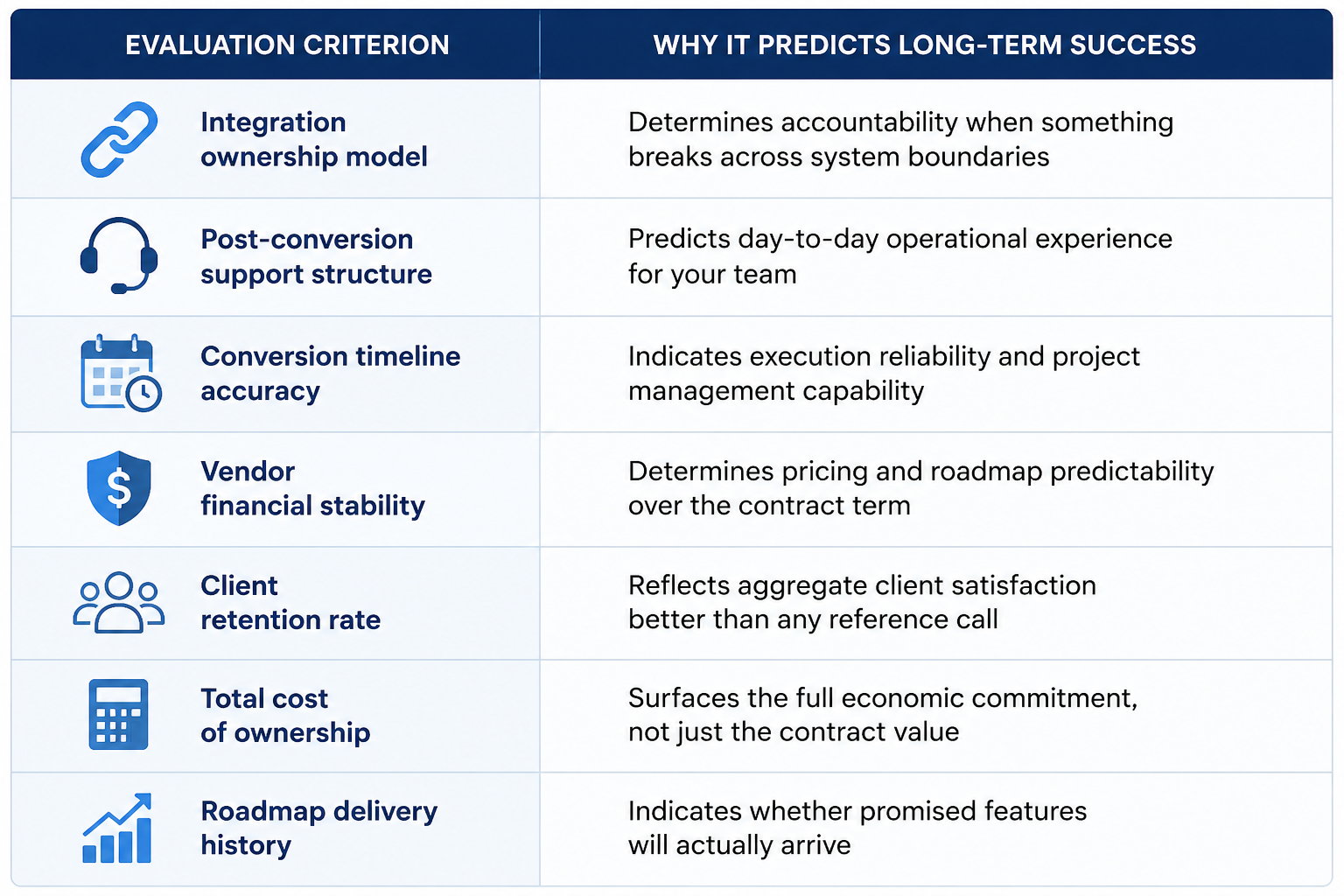
Criteria that get overweighted in standard RFPs:
-
Feature count (quantity doesn't predict quality or integration depth)
- Demo polish (reflects sales investment, not operational capability)
- Initial pricing (low entry pricing with aggressive escalation clauses is a common pattern)
- Brand recognition (larger vendors are not inherently better matches for sub-$1 billion institutions)
Phase 5: Negotiate a Contract That Protects Your Institution
The contract negotiation is where most credit unions leave the most value on the table, often because by the time they reach this phase, organizational momentum is already committed to a particular vendor, and the appetite for pushing back has diminished.
Terms worth negotiating specifically:
-
SLA remedies with teeth. SLA commitments that carry financial consequences if missed are fundamentally different from SLA targets that are aspirational. Negotiate specific credit or rebate structures to support SLA failures.
- Price escalation caps. Know exactly what your vendor's contractual right to raise prices is, and negotiate a cap. Annual escalation clauses of 3–5% compound significantly over a ten-year term.
- Conversion milestone accountability. If the conversion extends beyond the projected timeline due to vendor performance, what is the financial remedy? This should be explicit in the contract, not subject to later negotiation.
- Data portability and exit rights. Understand exactly what your data export rights are at the end of the term and what a deconversion would cost. Vendors with expensive or complex exit terms have less incentive to keep you satisfied.
- Integration maintenance commitments. If you are relying on an integration between the core and a third-party platform, document in the contract who is responsible for maintaining that integration when either system updates.
- Reference and case study rights. Understand what the vendor expects in terms of case study participation, conference presentations, and reference calls. These obligations have a cost to your team's time that's worth understanding upfront.
What Red Flags Should a Credit Union Watch for During a Core Evaluation?
After working through hundreds of credit union technology evaluations over two decades, these are the patterns I've seen most consistently predict a poor vendor relationship:
During the RFP response:
- Vague answers to specific operational questions ("our support team is highly responsive" instead of providing actual SLA data.)
- Reluctance to provide conversion timeline data or client retention rates.
- Pricing proposals that are significantly below market without a clear explanation of how they're sustainable.
During the demo:
- Sales representatives who redirect technical questions to follow-up calls rather than answering them in the room.
- Demo environments that don't reflect current production capabilities.
- Inability to demonstrate the specific integration workflow between the core and the digital banking platform your institution uses.
During reference calls:
-
References who are enthusiastic about features but vague about post-conversion support quality.
- Inability to connect you with a client who converted in the past 18 months.
- References who were converted by a different team than the one that would handle your conversion.
During contract negotiation:
-
Resistance to SLA remedies with financial consequences.
- Conversion milestone accountability that is aspirational rather than contractual.
- Complex or expensive data portability and exit provisions.
Any one of these patterns is worth flagging and addressing directly. A pattern of several is a meaningful signal about what the relationship will look like after the contract is signed.
What Does a Well-Run Core Evaluation Process Look Like End-to-End?
Here is a realistic timeline framework for a credit union conducting a thorough core evaluation:
Months 1 - 2: Internal Assessment and Criteria Definition
- Audit the current environment and document pain points.
- Define must-have, strategic priority, and nice-to-have criteria.
- Identify internal stakeholders and assign evaluation responsibilities.
- Select vendors to include in the initial RFP distribution. (typically three to five)
Months 3 - 4: RFP Issuance and Response Review
- Issue RFP with a 30-day response window.
- Score responses against defined criteria.
- Identify two to three finalists for deeper evaluation.
- Conduct initial reference checks to validate finalist selection.
Months 5 - 6: Demos, Site Visits, and Reference Calls
- Conduct structured demos with finalist vendors.
- Visit a live client site for at least one finalist if possible. What a production environment looks like is often more informative than a demo environment.
- Complete structured reference calls as described above.
- Request best-and-final pricing from finalists.
Month 7: Finalist Evaluation and Selection
- Score finalists on weighted criteria.
- Present board-level summary with recommendation.
- Obtain board approval.
Months 8 - 10: Contract Negotiation
-
Engage legal counsel experienced in technology contracts.
- Negotiate SLA remedies, price escalation caps, conversion accountability, and exit terms.
- Document integration maintenance responsibilities explicitly.
- Execute contract.
Months 11+: Conversion Planning
- Begin conversion project planning with the selected vendor.
- Establish a project governance structure with clear milestones and accountability.
A process this thorough takes seven to ten months before contract signature. That timeline is appropriate for a decision that will govern your institution's technology environment for the next ten years.
Key Takeaways: How to Evaluate a Core Banking RFP
- Define evaluation criteria before issuing the RFP. Tiered must-have, strategic priority, and nice-to-have requirements prevent feature-rich vendors from crowding out better-fit alternatives.
- Ask the questions vendors don't expect. Integration ownership, conversion timeline accuracy, support SLA data, and vendor financial stability are more predictive of long-term success than feature capability.
- Redirect demos toward operational reality. Live workflow walk-throughs, support portal demonstrations, and technical questions to engineers reveal more than any prepared demo sequence.
- Weight integration accountability heavily. The question of who owns a broken integration is the most important operational question in a multi-system environment.
- Negotiate contract terms with real remedies. SLA commitments without financial consequences are targets, not guarantees. Price escalation caps, conversion milestone accountability, and data portability rights are all worth fighting for.
- Run structured reference calls, not reference lists. Require conversations with recent converts and clients who've experienced support escalations. That's where the real signal lives.
- Budget seven to ten months before contract signature. A decision governing your next decade deserves a process that reflects its importance.
Frequently Asked Questions
How many vendors should a credit union include in a core banking RFP?
Three to five is the right range for most institutions under $1 billion. Fewer than three limits competitive pressure and may produce a less favorable contract. More than five creates evaluation overhead that reduces the quality of scrutiny each vendor receives. If you're working with a consultant, understand their vendor relationships. Consultants who receive compensation from specific vendors have incentives that may not align perfectly with your selection.
Should a credit union hire a consultant to run a core evaluation?
Consultants can add real value, particularly in structuring the RFP, managing vendor communication, and benchmarking pricing. The caution is around alignment: understand whether your consultant receives referral fees or other compensation from vendors in the evaluation, and how that might affect their recommendations. The criteria in this guide are designed to help you evaluate vendor quality independently, regardless of whether a consultant is involved.
How do you evaluate a vendor's financial stability during a core RFP?
For privately held vendors, financial statements may not be publicly available. Proxies include: ownership structure and whether it has changed recently, years in business, published client retention rate, annual R&D investment as a percentage of revenue, and whether the vendor can provide audited financial statements under NDA. A vendor that can't or won't provide any financial transparency is worth scrutinizing closely.
What is the biggest mistake credit unions make in a core evaluation?
Optimizing for the demo experience rather than the post-conversion experience. Vendor sales and demo teams are not the same as vendor implementation and support teams. The quality of the demo reflects investment in sales capability. The quality of the post-conversion relationship reflects investment in the teams your institution will actually work with for the next ten years. Structuring references specifically around post-conversion and support experiences is the single best corrective.
How do you evaluate a core vendor's digital banking integration during an RFP?
Ask for a live demonstration of the full workflow, from member-initiated action in the digital banking platform through to core posting, for your three highest-volume transaction types. Ask specifically who owns the integration layer, what the escalation path is when it fails, and how many clients are running the same digital banking platform you use. Integration depth varies significantly even among certified partners, and the RFP questionnaire alone rarely surfaces that variation.
Most credit union core banking RFP processes are well-structured for comparing features and pricing, but consistently underweight the criteria that determine whether a vendor relationship actually succeeds: integration depth, post-conversion support quality, vendor financial stability, and the operational overhead your team will carry for the next ten years. This guide walks through how to build an evaluation process that surfaces those factors clearly, including the questions most RFPs never ask, the demo red flags most institutions miss, and the contractual terms worth fighting for before you sign.



.png)