



Credit union technology stacks didn’t get “designed”; they grew.
Over years of new vendors, bolt‑ons, and quick fixes, many institutions now run on a maze of middleware that quietly taxes efficiency, inflates cost, and slows strategic change.
If your team spends more time reconciling systems than serving members, this article is for you.
Why Middleware Gets You Into Trouble
Middleware has a role, but when it becomes the primary way you connect critical systems, it shifts cost, risk, and complexity into the background where it’s hardest to manage.
Common signs you’re running a middleware‑heavy stack:
- Multiple nightly batch jobs just to keep systems in sync
- Different “truths” for balances, limits, or member contact data
- Projects that stall because three or more vendors need to change code
Core‑native integration flips this picture: instead of stitching around the core, you build with it.
Risk 1: Operational Fragility and Downtime
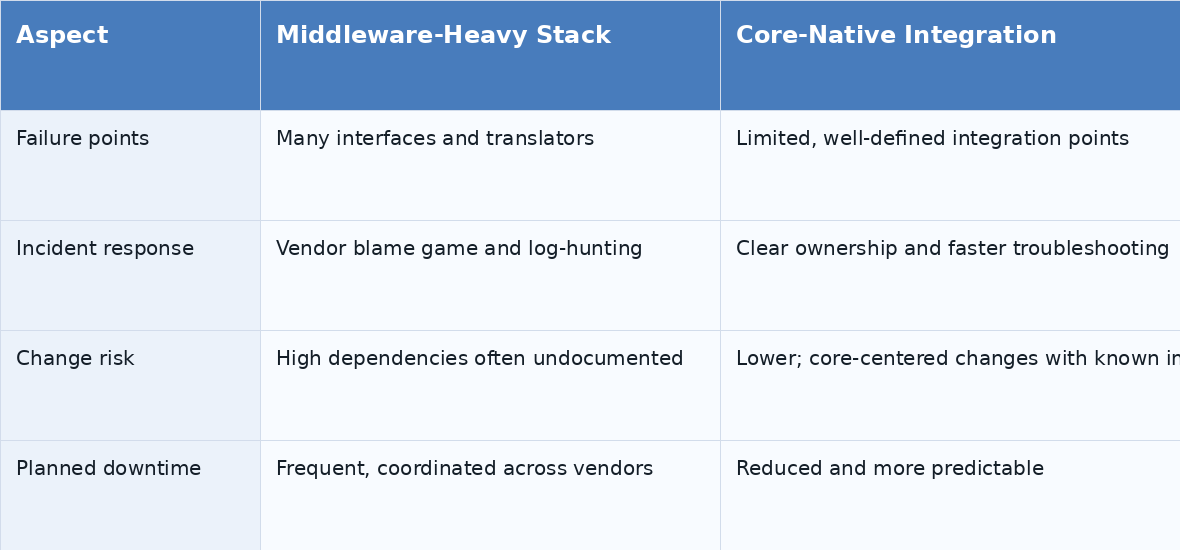
In a middleware‑heavy environment, every transaction passes through a chain of systems before it reaches the core. If any link weakens, your operations suffer.
Operational pain points:
- More failure points (interfaces, queues, translators)
- Longer troubleshooting cycles when “something broke overnight”
- Change freezes because any update may ripple unpredictably
How Core-Native Fixes It
Core‑native integration minimizes “hops” between systems and makes the core the real‑time system of record for both transactions and configuration.
Benefits:
- Fewer components to monitor and maintain
- Faster root‑cause analysis when issues arise
- More predictable change management and upgrades
Comparison: Stack Stability
Risk 2: Rising Total Cost of Ownership (TCO)
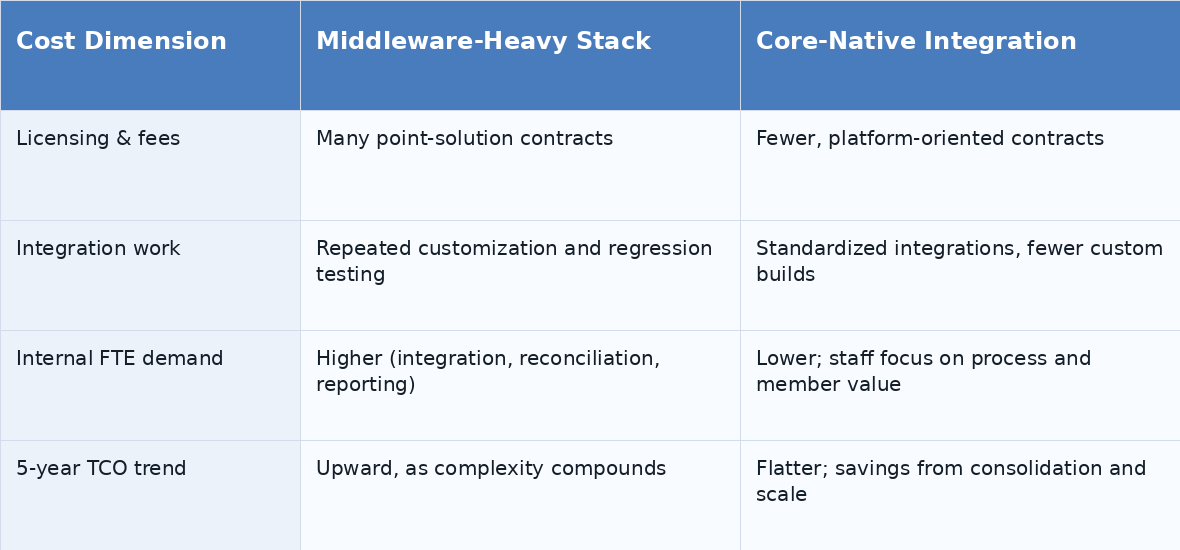
Middleware is often justified as a “cheaper” way to extend the core. Over time, the opposite becomes true.
Hidden cost drivers:
- Multiple maintenance contracts and support teams
- Custom interfaces that must be retested with every release
- Parallel monitoring, logging, and reporting tools
- Extra internal staff or consultants just to manage integrations
How Core-Native Fixes It
Core‑native solutions consolidate capability into a unified platform, reducing the number of vendors, interfaces, and custom integrations you must carry.
Financial advantages:
- Lower ongoing maintenance and interface management costs
- Less custom code to test, certify, and support
- Improved purchasing leverage with a strategic core partner
Comparison: Cost Profile
Risk 3: Incomplete and Delayed Data
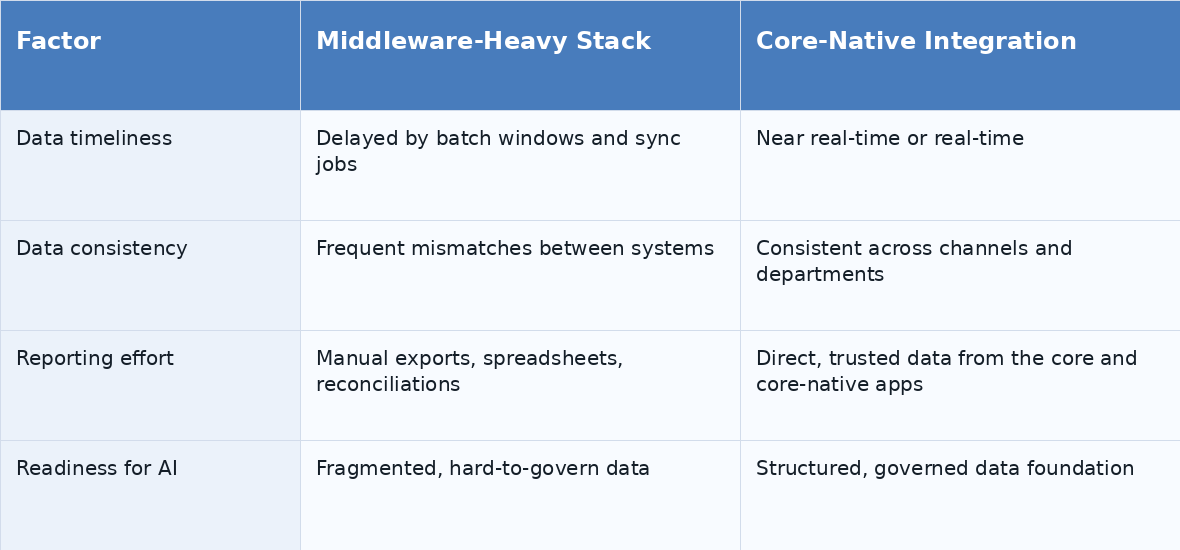
When data is scattered across systems and synced by batch, even simple questions become difficult.
Business impacts:
- Executives lack a single, timely view of member relationships
- Risk and compliance rely on exports and spreadsheets
- Marketing and lending work from stale or conflicting data
How Core-Native Fixes It
Core‑native integration treats the core as your authoritative, real‑time data engine, with tightly integrated modules feeding consistent information to every channel.
Data advantages:
- One source of truth for balances, activity, and member profiles
- Near real‑time insights for lending, pricing, and risk decisions
- Cleaner, more reliable data pipelines for analytics and AI use cases
Comparison: Data and Decision Quality
Risk 4: Slower Innovation and Time‑to‑Market
Every strategic initiative: new product, new channel, new partnership, eventually runs into “how do we integrate it?”
In a middleware‑centric world:
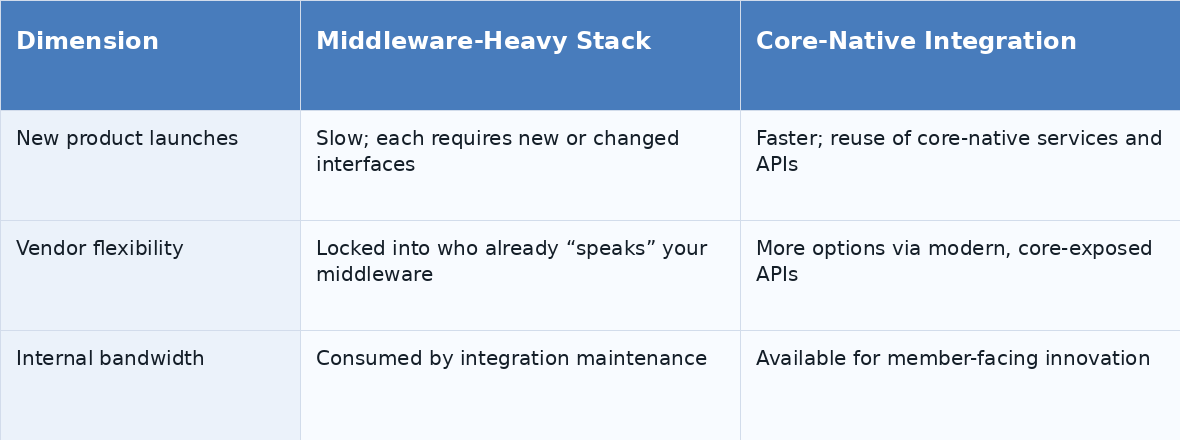
- Roadmaps are constrained by integration capacity, not strategy
- Vendors dictate timelines and scope via interface limitations
- Staff energy shifts from innovation to workarounds
How Core-Native Fixes It
Core‑native integration, combined with modern APIs, lets you build once on the core and then extend, rather than reinventing integration every time.
Innovation benefits:
- Faster rollout of new products and channels
- Ability to pilot and iterate without heavy integration overhead
- Stronger alignment between IT capability and business strategy
Comparison: Strategic Agility
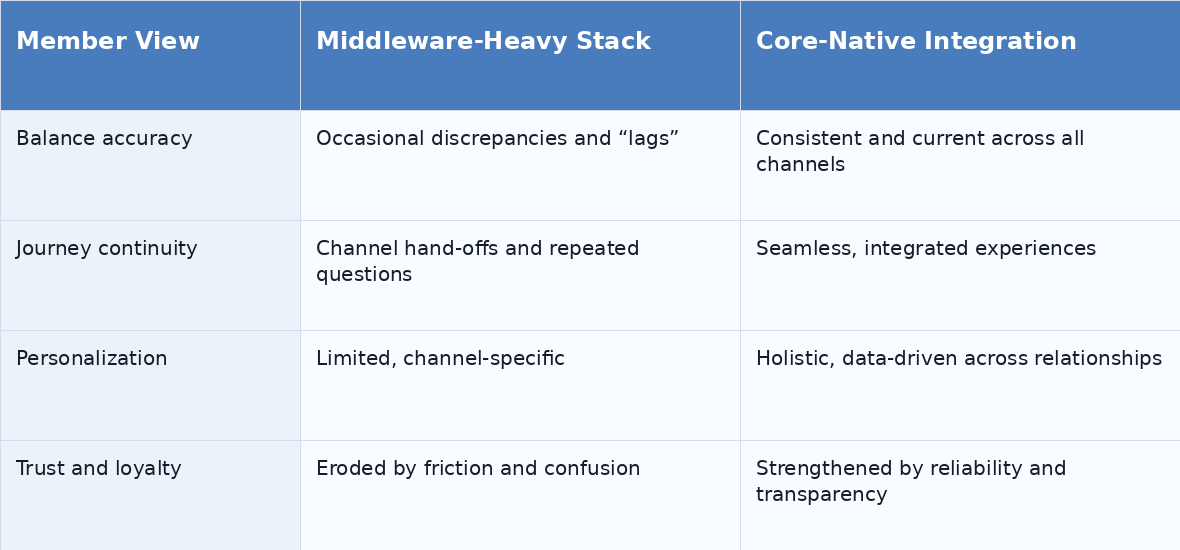
Risk 5: Member Experience Gaps
Members don’t see middleware, but they feel its effects.
Experience issues that trace back to middleware:
- Inconsistent balances or limits between channels
- Delayed posting, causing confusion or complaints
- Fractured journeys (start online, call support, visit branch)
- Limited personalization across channels
How Core-Native Fixes It
Core‑native integration aligns your channels, products, and workflows around a shared, real‑time view of the member.
Experience outcomes:
- Consistent information everywhere the member interacts
- Faster, cleaner transaction flows with fewer exceptions
- The ability to design end‑to‑end digital journeys, not channel silos
Comparison: Member-Visible Impact

A Practical Path from Middleware‑Heavy to Core‑Native
For most credit unions, the answer is not a risky “rip and replace,” but an intentional, phased shift toward a core‑native, API‑driven architecture.
1. Take Inventory of Your Middleware
- Map every integration and the data it moves
- Identify redundant functions across vendors
- Quantify support costs, incident counts, and upgrade pains
2. Prioritize High‑Impact Consolidation
- Target systems that:
- Touch many members or large volumes of transactions
- Require frequent manual work or reconciliation
- Block new initiatives or regulatory changes
- Ask: “Can this capability live natively in the core?”
3. Tighten Around the Core
- Move select capabilities into core‑native modules where possible
- Standardize on modern APIs for remaining third‑party solutions
- Retire custom interfaces as you bring new core‑native capabilities online
4. Measure and Communicate Wins
Track improvements such as:
- Reduction in number of interfaces to manage
- Fewer incidents tied to middleware or data mismatches
- Lower integration‑related project costs
- Faster delivery times for new products or features
Reporting these metrics back to your board reinforces that architecture decisions are business decisions, not just IT concerns.
What This Means for the C‑Suite
For CEOs, CFOs, and CIOs, middleware‑heavy stacks are more than a technical nuisance, they are a drag on growth, efficiency, and member value.
Key leadership takeaways:
- Middleware sprawl is a risk to operational stability and cost discipline
- Core‑native integration provides a cleaner, more controllable foundation
- Phased consolidation around the core can improve efficiency without disruptive “big bang” projects
- Architecture should be managed as a strategic asset, not just a technical detail
If your leadership team were to change just one thing in the next planning cycle, it should be to make “core‑native first” the default for every new capability you add.